
|
Early Childhood Music and the BrainThis page summarizes research into the effect of music and the brain and on the relationship between caregiver and child. We add new information as it becomes available. ________________________________________________________________ Why Introducing Music to Children is ImportantSome of the best research I have come across concerning music and brain development has come from articles authored or co-authored by Dr. Nina Kraus of Northwestern University. I am grateful that she shares her work online. Here are a few of her articles that I think you will find interesting. Dr. Kraus and her associates have proven several items which are of interest to families of young children. 1) Auditory processing in infancy [the ability to listen] is correlated with language, memory and cognitive function later in childhood. Kraus cites (Benasich et al., 2006 in her article Auditory-Processing Malleability: Focus on Language and Music pp. 108) 4) Musical training helps us to enhance and focus auditory processing skills. (Kraus, et al, Experience-induced Malleability in Neural encoding of Pitch, Timbre, and Timing: Implications for Language and Music, pp. 551) 5) Musical training helps us with speech and there is a transfer between the musical domain and the speech domain which is beneficial. (Kraus, et al, Experience-induced Malleability in Neural encoding of Pitch, Timbre, and Timing: Implications for Language and Music, pp. 545 and 549) 6) Music is an effective vehicle for auditory training. (Kraus, et al, Experience-induced Malleability in Neural encoding of Pitch, Timbre, and Timing: Implications for Language and Music, pp.549) 7) Musicians (vocal or instrumental) have less “harmonic jitter” in their voices. I am assuming that this makes their speech more pleasant to listen to. (Kraus, et al, Experience-induced Malleability in Neural encoding of Pitch, Timbre, and Timing: Implications for Language and Music, pp. 550) 8) Music has an important role in shaping sensory skills. (Kraus, et al, Experience-induced Malleability in Neural encoding of Pitch, Timbre, and Timing: Implications for Language and Music, pp. 554) 9) Kraus stresses that life-long music making is important to auditory processing. Note that this is not life-long music listening, but life-long music making. 10) Musicians can pick out sounds in noisy environments more quickly and more effectively than non musicians. For example, musical training is can help children pick out the teacher’s voice in the middle of a noisy classroom. Parbery-Clark A, Skoe E, Lam C, Kraus N. (2009) Musician enhancement for speech in noise. Ear and Hearing 30(6): 653-661.) So what we can learn from this research is that music and language skills are related and children who have musical training are better able to cope with noisy classrooms, crowds and focusing in on what they want to hear in their environment. We further learn that music making helps us with memory, with interpreting emotion and language and may make us more effective communicators by taking the “harmonic jitters” from our voices and smoothing them out so that they may be more pleasant to listen to. So how can we help our children to become life-long music makers? Music making is something that is passed down through generations. In their wonderful study, Lori Custodero and Elissa Johnson-Green found that parents were much more likely to sing to their children if they had been sung to as a child. They go on to report that the musical environment of the home and parent’s interests and involvement in music are key influences on children’s interest in music-making. (Custodero, L and Johnson-Green, E, (2002) Passing the Cultural Torch: Musical Experience and Musical Parenting of Infants, Journal of Research in Music Education, vol 51, no. 2 (Summer 2003). Pp.107)
Coming Soon! Why Lullabies are important for Mothers
Music and the Brain at Wikipedia Return Home from Music and the Brain
|

Sharing is Caring
_______________________
Online Musical Parenting Class
An online baby music class that makes parenting easier and more fun.

_______________________________
Award Winning Book for New Moms
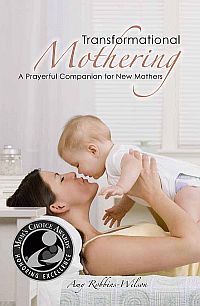
"Amy Robbins-Wilson has written a book that is honest, non-judgmental, and which honors mothers for the TRUE complexity of motherhood."
- Amazon Reviewer

______________________________________
Mom's Choice Awards
Gold Medal Winner
"I can not imagine a better way to lay a child to rest. The artist has the most angelic voice. Her work is like a whisper to the soul."
- Amazon Reviewer

________________________________________
CD of 33 Lullabies
Includes video course and downloadable lyrics book
Kids Music Award Winner
"...he was completely silent, no crying, no fussing, just absolutely silent, then I realized he was listening intently with every fiber of his body to the music, and after a good ten minutes of this he was sound asleep. Awesome!!! But the really really cool part is that I enjoyed the music too! It wasn't just silly nursery rhymes I didn't care about it was beautiful and ancient angelic sounds and lyrics that made me feel enveloped in a sacred space of beauty and importance. Like I was being honored and nurtured and held for being a mother"
- Amazon Reviewer
